












Malaysia Lets Tankers in Iran-China STS Oil Transfer Off with a Fine
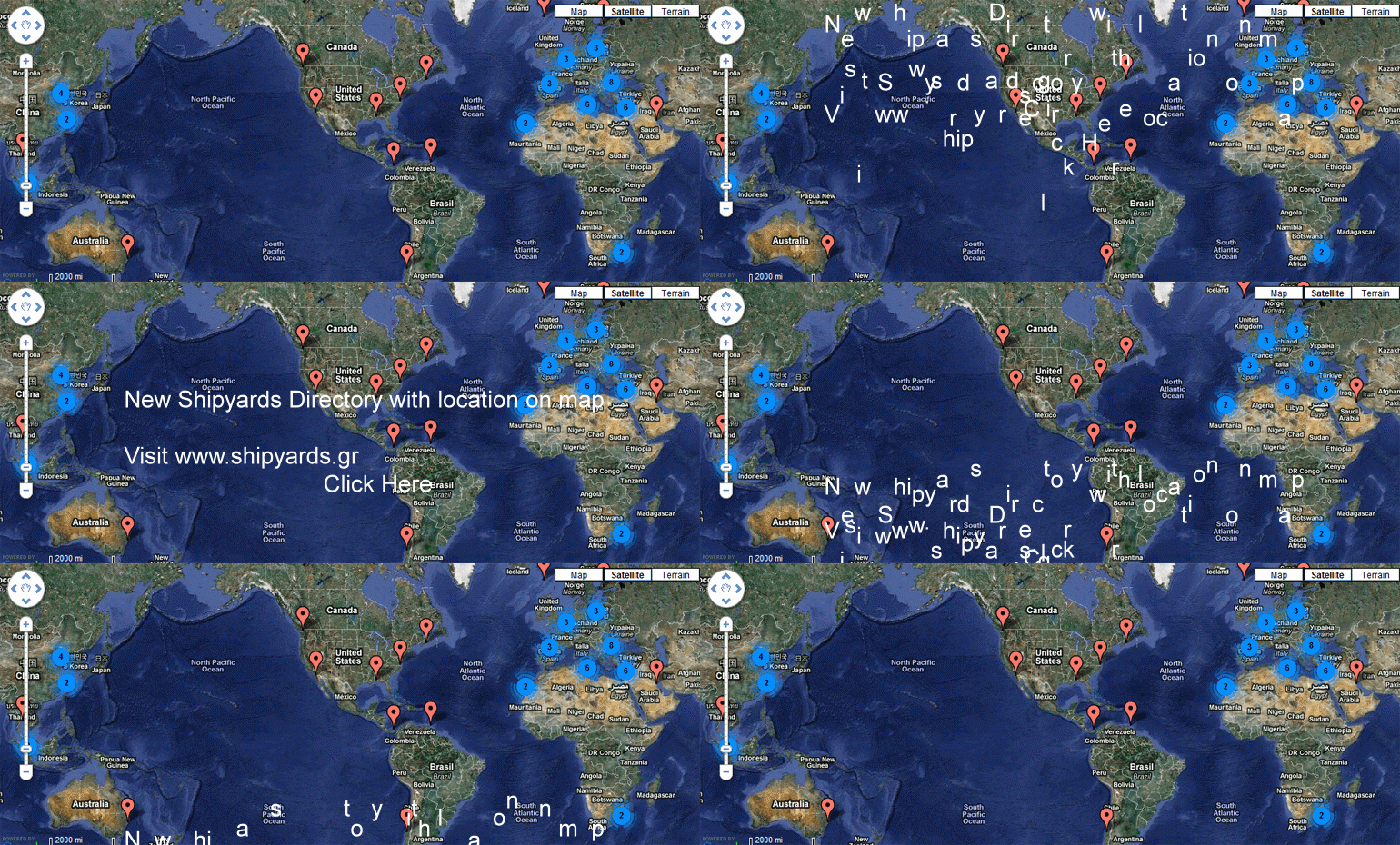
An area off Malaysia’s eastern Johore coastline has for several years seen a concentration of dark fleet tankers, many sanctioned, uninsured, flagless, and in poor seaworthy condition, engaged in the transfer of Iranian crude from tankers ex-Iran to tankers heading for China. This Ship-to-Ship (STS) “transfer box” lies wholly within Malaysia’s Exclusive Economic Zone (EEZ). International law and UNCLOS regarding STS are immature, but until recently, Malaysia has not sought to test its authority over STS activity in matters regarding marine safety and environmental protection.
This situation appeared to change on January 30, when a Penang State Maritime patrol boat caught two tankers in the process of carrying out an STS 24 nautical miles off Penang, on Malaysia’s west coast. The tankers involved were both sanctioned, the stateless Nora (IMO 9237539) and the Cameroon-flagged Rcelebra (IMO 9286073). The Malaysian authorities detained the crews and initially announced that the cargo was being seized.
After highlighting the seizure and reported “arrest” of the captains of the tankers, the ships quietly slipped away. Now, Captain Muhammad Suffi Mohd Ramli, the Penang maritime director at the Malaysian Maritime Enforcement Agency, confirmed that both vessels had been released on payment of a bond of $76,000, the value of the maximum penalty that can be imposed under Malaysian maritime law for conducting an unauthorized STS transfer.
The Nora headed west, presumably back towards Iran, and the Rcelebra, evidently still laden with a cargo valued at $129 million, passed Singapore through the Malacca Straits and is now anchored off Johore.
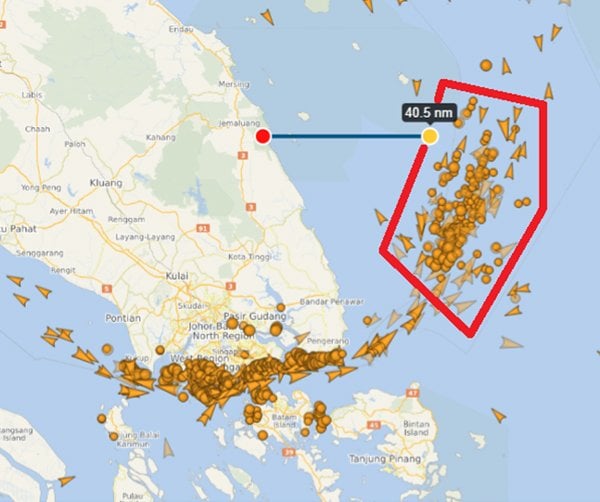
The Ship-to-Ship "transfer box" in Malaysia’s Exclusive Economic Zone (VesselFinder/CJRC)
The sequence of events indicates that while the Malaysian Maritime Enforcement Agency seeks to enforce Malaysian environmental and maritime safety ordinances, it is not tasked with enforcing U.S., UK, EU, or UN sanctions, nor observing IMO decisions on STS activities.
The United Against Nuclear Iran (UANI) organization estimates from satellite imagery that STS activity off Malaysia has doubled in the last 12 months, with an estimated 60 oil tankers loaded with Iranian crude oil, while another 10 tankers from Russia and 20 from Venezuela are currently waiting to receive cargoes, all in the STS transfer box east of Malaysia’s Johore coast.
Iran is still selling 80 percent of its crude exports to China, at volumes that have changed little in the last 12 months. A slight reduction in deliveries to China in the last quarter of 2025 is attributed by Kpler to very high levels of Iranian stocks being held afloat, amounting to some 166 million barrels, but also in tank farms servicing China’s teapot refineries. 166 million barrels is equivalent to 50 days of Iranian oil production, meaning that Iran has a buffer should a conflict with the United States result in a disruption to crude lifting from Iranian terminals.

that matters most
Get the latest maritime news delivered to your inbox daily.
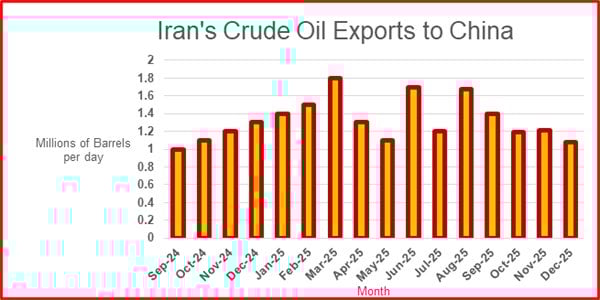
Iranian crude exports to China estimated from Kpler and Vortexa analysis (CJRC)
Content Original Link:
" target="_blank">