














USCG Requests Proposals to Replace Outdated Light Icebreakers
The U.S. Coast Guard is looking to urgently move forward with its planned replacement program for its badly outdated Light Icebreaker class that dates to the 1960s. It posted a Request for Information providing just two and a half weeks for responses while saying it contemplates streamlined approaches related to contract design, reduced government oversight, source selection, and contract requirements.
Icebreakers proved even more vital in 2026 in a winter that saw a deep freeze overtake much of the eastern United States. While much is made of the icebreaker efforts on the Great Lakes, equally important operations keep the harbors and vital waterways of the Northeast from Maine to Virginia functional. In New York City, for example, passenger ferry service was disrupted this winter on several occasions due to ice flows in the Hudson River and surrounding waterways, with the Coast Guard called in to aid.
In its fleet assessment, USCG notes that the aging fleet of 65-foot light icebreaking tugs (WYTLs) were commissioned into service between 1961 and 1967 and are well beyond their planned end of service life. A fleet of 15 boats was built, with the last commissioned in May 1967, and they continue to operate along the East Coast and several inland locations.
The new design, known as the Homeland Security Cutter Light Icebreakers (HSC-L), will replace these critical assets along with the current 49-foot buoy utility stern loading boats (BUSLs). It will be a new class, dual-capability platform, maintaining year-round access to smaller ports and harbors.
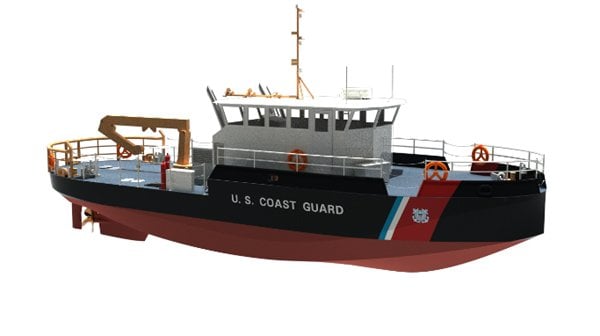
Concept design for the new vessel, which will be an icebreaker and handle buoys (USCG)
The proposal calls for vessels at 70 feet or less in length with 7 feet or less of draft. The vessel will be capable of independently breaking freshwater ice with a thickness of 12 inches at a continuous speed of 3 knots. In addition, it is to be capable of deploying, retrieving, and stowing at least three buoys with moorings. As such, the Coast Guard says the new vessels will be able to perform vital tasks such as quickly restoring damaged or missing navigational aids after storms or accidents. The Coast Guard plans to build seven HSC-Ls.

that matters most
Get the latest maritime news delivered to your inbox daily.
The current RFI follows a prior step last October. The Government anticipates a requirement for the production-ready design, production engineering, construction, test, and delivery of up to seven HSC-L vessels. The Government has developed a Contract Design (CD) baseline, which will require further maturation by the contractor to a production-ready design, followed by vessel construction and delivery.
While much of the attention has gone to the replacement heavy icebreakers and the Trump administration’s recent contracts for up to 11 large icebreakers, these small vessels play an equally critical role. The Coast Guard is anxious to replace these vessels, but it also recognizes the need to replace its aging medium icebreakers, comprised of the 140-foot Bay-class icebreaking tugs, which were commissioned into service between 1978 and 1988. It anticipates building 11 of these vessels, which are used primarily on the Great Lakes and along the Atlantic seaboard and can also be used to support search and rescue operations.
Content Original Link:
" target="_blank">