












Global insurers pull war risk cover amid Gulf escalation
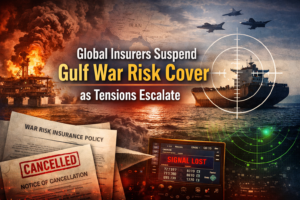

Global insurers have begun withdrawing war risk cover for parts of the Middle East following the latest military escalation in the Gulf. The move reflects a sharp contraction in reinsurance appetite and has introduced fresh uncertainty for shipowners and charterers operating in the region.
Coordinated Cancellations by Major P&I Clubs
Leading P&I Clubs, including Gard, Skuld, NorthStandard, West of England P&I Club, and the American Club, have issued formal Notices of Cancellation for certain war risk covers.
Most cancellations take effect at 00:00 GMT on 5 March 2026, following the standard 72-hour notice period.
The exclusion zones cover Iranian territorial waters (up to 12 nautical miles offshore) and the wider Persian/Arabian Gulf, including the Gulf of Oman.
The measures mainly affect non-mutual, fixed-premium business such as Charterers’ Liability and non-poolable extended covers. Core mutual P&I cover for shipowners remains in place but is under continuous review.
Premium Spikes and Voyage “Buy-Backs”
The withdrawal of annual cover does not mean insurance disappears entirely. Instead, it shifts the cost burden sharply upward.
Market estimates suggest marine hull rates for Gulf transits could rise by 25% to 50%, with some cases potentially doubling.
Several clubs are offering reinstatement through voyage-by-voyage “buy-back” arrangements. These provide limited cover at materially higher premiums.
Insurance Now a Transit Gatekeeper
The Joint Maritime Information Center (JMIC) has elevated the regional maritime risk level to CRITICAL.
According to its 1 March 2026 advisory, insurance availability has become a primary gating factor for transit decisions. Even without a formal closure of the Strait of Hormuz, the inability to secure affordable cover is effectively halting commercial sailings.
JMIC also reports severe GNSS/GPS interference and AIS disruptions, particularly near the Iranian coast. This degraded positional integrity increases navigational risk and the potential for miscalculation.
At the same time, vessel clustering near UAE and Omani ports is creating secondary hazards, including collision exposure and restricted maneuvering space.
Contractual and Operational Implications
Shipping companies are now in a temporary reactionary pause as they assess the 5 March effective dates.
With reinsurance capacity tightening and military tensions remaining high, operators are reviewing Force Majeure clauses and Safe Port warranties. The loss or unavailability of insurance may provide legal grounds to refuse orders to enter newly excluded zones.
The insurance market’s response has effectively transformed risk perception into a commercial barrier, one that could slow Gulf trade even without additional military escalation.
The post Global insurers pull war risk cover amid Gulf escalation appeared first on Container News.
Content Original Link:
" target="_blank">