









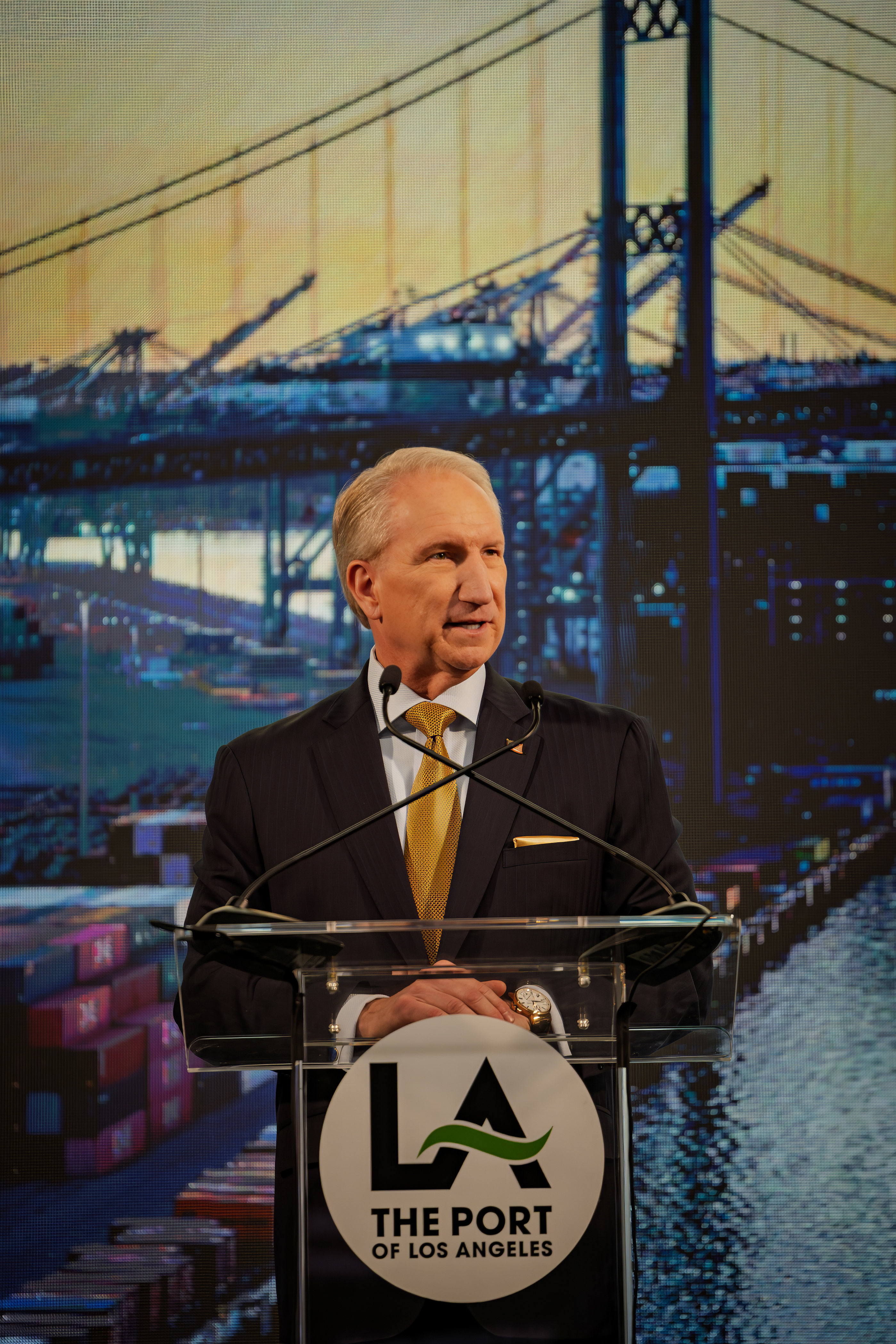
Interview with Gene Seroka, Executive Director of the Port of Los Angeles
In this exclusive interview, Container News journalist, Antonia Saratsopoulou speaks with Gene Seroka, Executive Director of the Port of Los Angeles, the nation’s busiest container port and a vital hub for global trade.
The discussion unveils the Port’s current operations, infrastructure projects, sustainability initiatives, cargo trends, and the role of the Port within the broader West Coast supply chain. Also, mr Seroka, looks ahead to the opportunities and challenges that lie on the horizon for one of the most critical gateways in the United States.
- The Port regularly shares container statistics, including a strong February report marking one of the busiest Februarys on record. How would you describe the Port’s current operational performance and cargo trends, especially in light of both that data and recent trade policy volatility?
The port is really running on all cylinders. The vital statistics that I look at on a dashboard every morning for performance are at or better than they were before COVID-19. So, the cargo is moving very swiftly. In the first two months of the year, we were down a few percentage points compared to very elevated numbers last year, because many importers tried to advance inventories and stock up before the tariffs came into play.
So, I’m very proud of what our workforce has done and really happy with the American economy and the consumer spending, which means so much to us. Even with all this uncertainty in world trade, the economy continues to move and we’re bringing cargo right there for it.
- With major projects underway, including the Pier 400 on‑dock rail expansion, the joint DEIS/DEIR for the Berths 121–131 container terminal redevelopment, and the newly proposed Pier B container terminal, how is the Port planning to increase capacity and improve cargo flow to meet future global demand?
This port is busier, cleaner, safer, and more fun to visit than ever. Our financial standing is as strong as it has been in generations. It’s our belief we must invest through budget cycles, economic cycles, and even election cycles.
So, our eye is on the decades ahead to make sure that we can capture cargo growth, the imagination of our visitors and serve our community to the highest standard. Our Head of Development, Dina Arien Zelin, has more than 160 capital Projects on her dashboard and the continued emphasis on revenue generating locations as well as visitor serving continues to drive our way to design, develop and deliver on all these projects. More than $12 billion worth of projects on paper right now, with much more investment behind that from the private sector.
- What role do infrastructure restoration projects, for example, the recently completed Berths 177-182 wharf restoration, play in ensuring resilience and continuity of operations at the Port?
Well, that’s a unique case, Antonia, and unfortunately, several years ago that particular area was ravaged by a fire. So, it was important for us to rebuild, and build back better than it was so we could help our steel and bulk industries, and a very important customer of the port continue to move their business.
So not only are we planning for the future, but sometimes we are evaluated on how quickly we can react to improve a situation coming off a very important issue.
- The Port’s Port Optimizer
 platform is a digital tool for improving throughput and supply chain visibility. How has the integration of Port Optimizer and related technology platforms changed operational planning and stakeholder coordination?
Well, with digitalization, this was probably one of our most important efforts over the last decade. We’re now able to see cargo 40 days before it arrives in Los Angeles so we can plan our great skilled labor, the machinery and the land that’s needed for that cargo.
Integrating now into other areas like sustainability, and the recently introduced truck reservation system has shown that we can gain efficiency and improve productivity using digital information. It was a long road. We had to earn trust. We had to find ways to add value, and we had to make sure that confidence was built with our private sector partners to know that their investment in proprietary technology was always going to be safe.
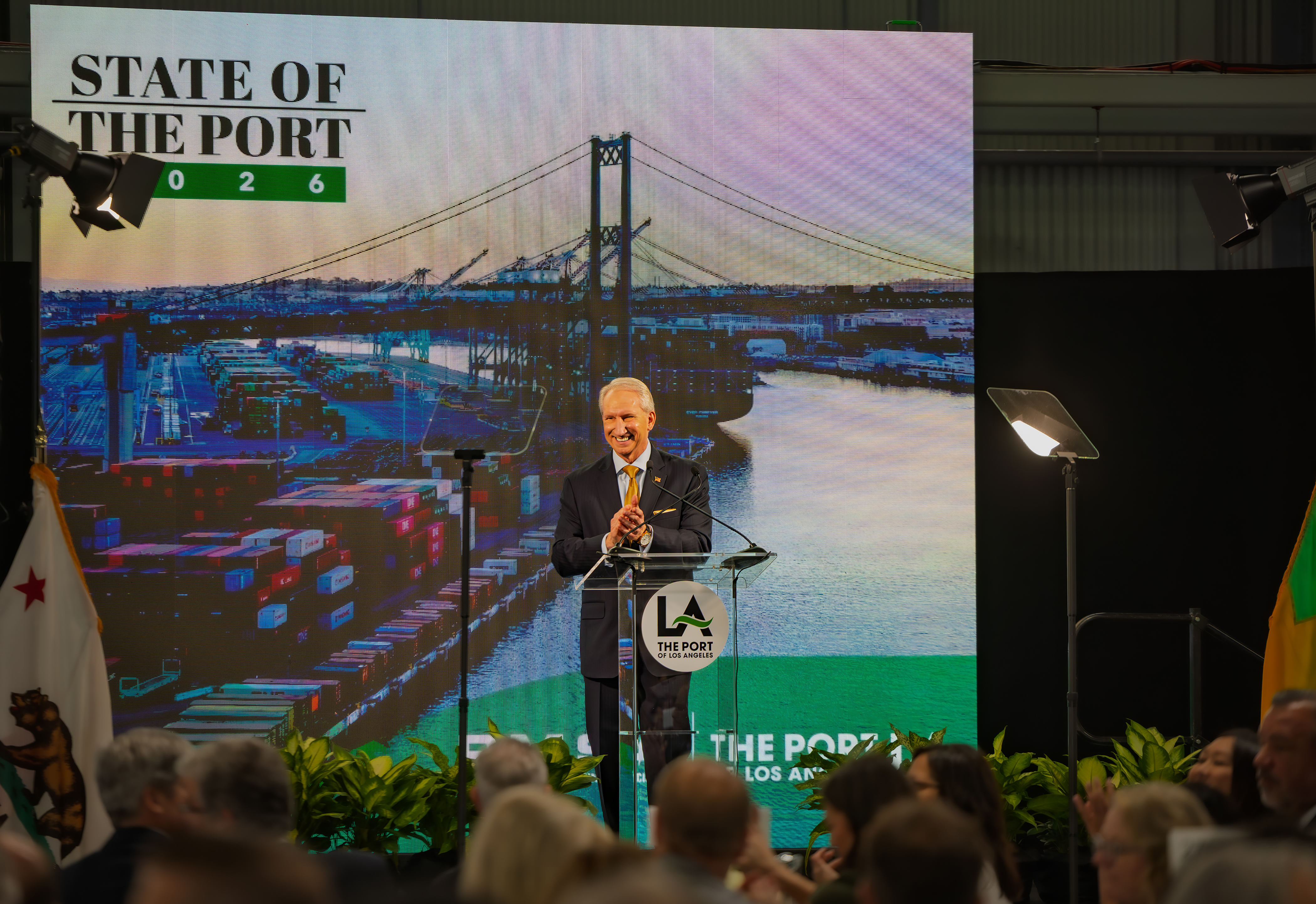
- The Port has secured significant federal funding and entered cooperative agreements to accelerate zero-emission infrastructure and technology. How are these sustainability initiatives shaping the Port’s operations and long-term environmental goals?
These goals are the most aggressive in the world, and today I can report to you, Antonia, that our pollution footprint per container is the lowest it’s been since we began measuring 20 years ago. We’ve made great progress. There’s more to do.
Federal, state and local investment from government means that the private sector will have confidence to invest along with us. This is very important in order to accelerate technology and gain adoption of newer equipment that will drive these pollution numbers down.
I’m equally proud of the work that we’re doing internationally on green shipping corridors. In fact, we brought in the first E-methanol vessel to the United States, the Maersk Alette, which was a 16,000 TEU ship sailing from central China.
Effectively the first ever zero emission voyage in the Transpacific to the United States. So, there’s much more work ahead of us, but it takes partnerships from government to private sector, and communities all combined to drive these goals.
- With the Port’s Clean Truck Spending Plan guiding investments in zero-emission trucks and related infrastructure, how significant is the drayage fleet transition in achieving broader environmental targets and operational efficiencies through 2035?
Next to the ocean-going vessels, this is our biggest opportunity to reduce pollution. There are more than 17,000 trucks registered to do business at the twin ports of Long Beach and Los Angeles, and we have about 450 that are zero emissions capable today.
So again, we have a long way to go. The price points are very high, and the infrastructure is not as dense as we would like. All areas that we’re working on today with our partners across government and the private sector, we need to continue to deliver value and we need to bring these prices to a manageable level.
More than half of our trucking companies are small businesses that own 5 rigs or less. They simply can’t afford to pay double or triple even more than what a diesel truck cost today.
So, we’ll continue to find ways through the Clean Truck program, other vouchers and incentives, along with policy changes that limit taxation, so these small companies can have a real opportunity to succeed in the future.
- The Port released a Draft Environmental Impact Report for both the Terminal Island Maritime Support Facility and the Berths 121–131 container terminal redevelopment. How will these planned facilities enhance Port operations and logistics efficiency once implemented?
On the Marine Support facility located in Terminal Island, is meant to be a multi-purpose facility with a flyover, so trucks can move in and out without slowing down the trains. It can act as a safety valve when cargo volume is high.
Chassis repair, truck staging area, export location for that all important earliest return date, over on the berth side modernizing so we can handle the bigger ships and provide rail and truck gate with to handle more cargo all developing.
Because for every four containers, we create a job that’s most important for economic development and the betterment of our community.
- As America’s busiest container port and a central node in global trade, how does the Port of Los Angeles view its role and strategic advantages within the West Coast supply chain ecosystem, particularly in collaboration with inland transportation partners?
This is a tremendous effect. The cargo that moves through the Port of Los Angeles not only reaches all 50 states, but each and every of our 435 congressional districts across the country. It is likely that if you’re wearing or sitting on a product or using one, it came through the port of Los Angeles.
Now the connectivity to get to all those locations is important by truck and rail. That’s why decades ago we invested in our infrastructure to have all 7 container terminals equipped with on dock rail capability.
We also built, along with the Port of Long Beach and the Western Railroads, the Alameda Corridor, a 22-mile connector to the Transcontinental Railroad that removed over 200 grade separations on surface streets.
That connectivity of intermodal cargo from the port accounts for more than 2/3 of all of our business.
- Looking five to ten years ahead, what do you see as the biggest risks and opportunities for the Port of Los Angeles and the broader West Coast supply chain?
Well, the World Trade order and relationships across the globe are changing, running right in front of our eyes. It’s our belief in the city and Port of Los Angeles that those international relationships are absolutely sacred.
That’s why I travel so much, spend so much of my day in front of customers, partners and stakeholders, to continue to prove that the Port of Los Angeles is important to those relationships. Making sure that we stay relevant with our shipping lines, importers and exporters to move cargo and create that economic value is part of every single conversation that I have.
We’ll see how all this lands in the next year or two. But realistically speaking, 70% of America’s economy is based on consumer spending. Much of that consumer spends is on products that come from overseas.
We only consume about 1/3 of what our American farmers harvest. The balance 2/3 goes to renewable energy and overseas markets. The international component of what we do is so vitally important to the American economy and American family. I’m so proud that we at least can play a small role in helping advance those discussions.
- Following the recent Supreme Court ruling that struck down tariffs imposed under IEEPA (International Emergency Economic Powers Act), your statement noted that about two- thirds of the tariffs collected may be rescinded, but there remains uncertainty about possible refunds and the timing of a newly announced 10% global tariff.
At the same time, markets and international partners, including the European Commission, have emphasized the need for predictability and clarity in trade policy. How is this combination of legal and policy uncertainty affecting cargo flows, shipper behavior, and operational planning at the Port of Los Angeles, and what steps is the Port taking to manage these potential fluctuations?
Well, first, even to the most seasoned professional, all of this information around tariffs and trade policy is very confusing. I would state that the 2/3 tariffs that were rescinded by the Supreme Court, amounting to about 170 billion U.S. dollars, are injected back into the economy.
We still have to find a mechanism to do that, but that would stimulate economic growth at a time when job hiring is low, capital investment is lighter than many would like, and job openings at 6,000,000 positions is also quite soft.
We need to find a way to get the American consumer back in the game at a higher level. When every American family now is watching their budget so closely, the price of gasoline or petrol has risen by more than a dollar a gallon over the last three weeks, bananas and coffee are up 10% at the grocery store year over year, health care and education costs continue to soar. We need to find ways to make the economy and the consumer more competitive.
The post Interview with Gene Seroka, Executive Director of the Port of Los Angeles appeared first on Container News.
Content Original Link:
" target="_blank">


