










Interview with Matthias Dietrich, Senior Director Strategic Programs at Hapag-Lloyd AG


In this exclusive interview, Container News journalist Antonia Saratsopoulou speaks with Matthias Dietrich, Senior Director Strategic Programs at Hapag-Lloyd AG.
The discussion explores the company’s strategic direction, recent initiatives, and how it is navigating geopolitical uncertainty, digital transformation, and the industry’s decarbonization journey in a rapidly changing global trade environment.
- What are Hapag-Lloyd’s key strategic priorities over the next 3–5 years, and how do they align with the company’s long-term vision in a rapidly changing global trade environment?
We formulated our strategy 2030, two and a half years ago, that is leading us through this decade. In this strategy we defined five key priorities or five building blocks.
The first one is a pure play plus that means we will remain focused on our core business of ocean container shipping. We will not become an integrated logistics company.
There are two exceptions and therefore the plus in pureplay plus.
We are investing in terminals, and we want to improve our inland door-to-door offering for our customers. The second block is that we want to remain a top five container line. With the other lines, ideally gain modestly in market share and not let the distance to our bigger competitors become too big to maintain our economies of scale.
The third block is to be the undisputed number one for quality. That’s our aspiration and that is maybe our core message to the market and at the heart of our identity. Also, this is underlined by our new brand campaign (“Your cargo, our promise”) that we just launched.
The fourth block is the sustainability driver. We are really committed to doing our share in protecting the environment and our climate.
That is out of conviction, but it’s also because we believe that long term it remains a business imperative, despite some recent developments.
The fifth is that we want to be a top performing carrier. This is not only pointing to the necessity that we have to earn our cost of capital and satisfy our shareholders, but also that we want to invest in our people and to stay ahead in the technological game.
So, these are the five strategic priorities basically for us for the next years.
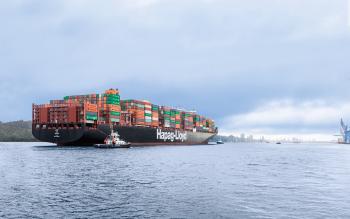
- What recent strategic initiatives or investments has Hapag-Lloyd undertaken that you consider most critical for maintaining competitiveness and growth?
Let me point out two things that are maybe of particular significance that we have done in the last couple of years.
Firstly, we set up our terminal division, Hanseatic Global Terminals.
Now it has more than 20 terminals on five continents, as alongside shareholdings we have further plans to grow there.
Secondly is the Gemini Alliance that we started a year ago with our partners.
We really reset the way we run our network on the East West trades, and was also a quantum leap for our customers, in terms of schedule reliability.
- How do you see current geopolitical tensions, trade policy shifts, and regionalization trends reshaping global container shipping and supply chains?
Our experience is that with all the geopolitical tensions that you mentioned and that we certainly all felt and read about, the market has been remarkably resilient.
So, we have seen continued growth throughout all these years. We have seen some shifts in trade patterns, some trades growing faster than others, but so far, we have seen a relatively stable market on the demand side. We expect this trend to continue. We will not return to the very high growth rates that we maybe had a long time ago, but we will see steady growth.
Even with persistent geopolitical tensions, I don’t think we will return on the kind of political level to a world where we had maybe until 2016, but we will still
see persistent trade patterns.
To put it more poignantly, the Europeans and North Americans will not grow their own coffee or their own bananas, and industrial production chains are not easy to shift. So, we are moderately optimistic about that.
- What role do digitalization and data analytics play in Hapag-Lloyd’s strategic programs, and how is technology changing the way you serve customers?
It’s playing a big role for us as for probably everybody in the industry, and we have heavily invested and drastically increased our IT capabilities over the years.
I’m proud to say that in an independent survey that we recently conducted, Hapag-Lloyd was ranked as number one in digital customer experience.
Our customers also recognize these investments that we made.
Let me give you an example regarding “life position”, which is our tracking product for our containers. We are the first and so far, only shipping line that has equipped our entire fleet with tracking devices, which enables us to give position information about the whereabouts of the containers throughout the entire transport chain.
That is really a distinguishing factor for our backlot that we are trying to build on. Other than that, as probably everybody else, we are looking into AI, especially Agent AI.
We are trying to bring that into use for our customers and for the efficiency of our business.
Our AI-powered case classification now classifies customer cases more accurately
and fast, and that helps also improve the service for our customers and be able to respond to them. We’re not trying to replace the human touch. I think that’s very important to us and to our customers, but we think we can improve our customer service, through AI and other digital means.
We are doing all these initiatives under the internal headline of “AI is the new digital”. So, everything will probably move to AI empowered systems, over the course of the next years.
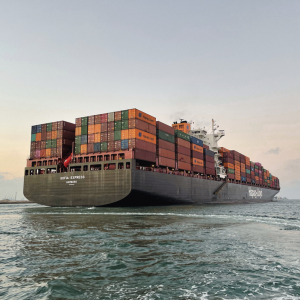
- Shipping faces increasing pressure to decarbonize. How is Hapag-Lloyd approaching sustainability, and what are the main challenges and opportunities in this transition?
Decarbonization and sustainability are one of the five core pillars of our strategy, and we remain committed to that. We have a goal of being net zero and in terms of greenhouse emissions by 2045.
On top of that, we also want to reduce our absolute emissions by 1/3 by 2030, compared to the 22 baseline. So, that is an ambitious goal, and we are endeavoring to achieve it, through 4 levers.
The first is fleet renewal, replacing older, less efficient ships with newer, more efficient and bigger that have been a per TEU higher efficiency.The second one is to upgrade the existing fleet with measures that reduce consumption and emissions.
The third one is network efficiency, which is basically adjusting our routing and speed and port rotations to be more efficient.
The fourth lever is the alternative fuels and sustainable fuels, where we are already securing long-term supply agreements for green methanol for example.
We are investing in dual fuel shifts that can also burn these fuels in the end. We are aligned in our goals with the Paris agreement and the 1.5-degree pathway.
Despite some challenges that we see with the postponement of a decision by the IMO for the Net-Zero framework, we are still committed to continuing this path.
- How are customer expectations evolving, and how is Hapag-Lloyd adapting its service offerings to deliver greater reliability, transparency, and value?
Customer demands are always evolving with technical progress. But at the same time, we also see in our market research that some basic things remain stable and consistent over time.
There is a sizable segment of the market that values quality, and that is not only looking for the cheapest price, but that is looking for good quality service. A core of our strategy is to target that market segment by being a quality carrier for this customer segment.
Within the kind of realm of quality, the most important element is the quality of the physical product, which basically means schedule reliability, and more importantly the on-time delivery of the container on box level.
That’s where we are very happy to have made a quantum leap with the Gemini cooperation, where we have achieved the 90% schedule reliability that we targeted. But we are not going to stop there.
We know that on the non-Gemini network, we still have some potential to further improve, and on the box level we know that we have potential and we have actually made some improvements there last year already and we want to improve further in this regard,
In parallel to that, we are improving also our kind of customer service, which is not the physical product, but more how we interact with our customers, and our digital product along with the quality promises that we are publishing.

- Following the limited return of the Gemini service through the Red Sea and Suez Canal, what strategic considerations and risk assessments is Hapag-Lloyd considering in resuming regular sailings, and how does this align with its broader approach to partnerships like the Gemini Cooperation and managing geopolitical uncertainties?
The priority that we have is always the safety of our crews, the vessels and the customers’ cargo. We will never compromise on that, especially when human lives are at stake.
We are of course continuously monitoring the situation, not only in the Red Sea, but in all kinds of areas where there might be dangers, and in a more uncertain world, we will probably have to continue to do so.
And based on the careful risk assessment that we did jointly with our partner in the Gemini cooperation, we came to the conclusion to bring back one service through to the Red Sea, through the Suez Canal with certain precautions, and we will continue to look how this goes and if the conditions remain stable and permit, we will evaluate the gradual reintroduction of additional services. I think that the first ones would be SE1 and SE3 at a later stage.
- Looking ahead, what do you believe will be the most significant structural changes in the global shipping and logistics industry over the next decade, and how is Hapag-Lloyd preparing for them?
Structural changes are very hard to predict, and we humans are not very good at that. Who would have predicted the pandemic and everything that happened to the shipping industry?
So, it remains a bit of an uncertainty that we cannot resolve. But I think that two mega trends will continue, and they will shape structural changes and will shape our industry.
The first is developments around automation and A I that will change the way we work, and we interact with our customers and our suppliers.
The second one is that decarbonization will stay high on the agenda, or it will become more prominent again after recent developments and this will require massive investments, and a lot of innovation.
So that is also something that will be of concern for the next years for us.
The post Interview with Matthias Dietrich, Senior Director Strategic Programs at Hapag-Lloyd AG appeared first on Container News.
Content Original Link:
" target="_blank">